Persian MS 213 (The John Rylands Research Institute and Library, The University of Manchester)
- Display:
-
Persian Manuscripts
Contents
Summary of Contents: A prominent, Safavid-era calligrapher Muḥammad Shafī‘ Qazvīnī (d. ca. 1750), known as Khalīfat al-Khulafā' (Regent of Regents) completed this manuscript of the Mas̲navī-i Ma‘navī (Spiritual Couplets) by Jalāl al-Dīn Rūmī on 22 Shavvāl 1105 AH (16 June 1694 CE). The son of ‘Abd al-Jabbār (d. 1654–55), a leading student of the preeminent Safavid master of nasta‘līq script, Mīr ‘Imād al-Ḥasanī (d. 1615), he ultimately served as librarian to Shāh ‘Abbās II (b. 1632, r. 1642–1666) in Isfahan, but then after the death of his father retired to Qazvin, where he probably copied this volume. Originally comprised of six separate booklets that subsequently suffered severe damage, then subsequently restored, with numerous quires replaced, losses expertly infilled, and incomplete passages re-written in two different hands then rebound, efforts likely due to admiration for the scribe. It also contains a seventh apocryphal volume added during restoration.Compiler: Sulṭān Valad, 1226–1312;
سلطان ولدScribe: Muḥammad Shafī‘ Qazvīnī (d. ca. 1750)
محمد شفيع قزوينىTitle: Mas̲navī-i Ma‘navīTitle: مثنوی معنویIncipit: (basmala) برگ ۱پ (folio 1b): هذه الاسرار القدسیة والانوار الروحیة واللایحات الخفیة والالهامات الجلیة والاشارات الغرIncipit: برگ ۱۳پ (folio 13b): بشنو از نی چون حکایت میکند * از جدأیها شکایت میکندExplicit: برگ ۴۶۷ر (folio 467a): آمد از دوگاه شاه معنوی * دفتر هفتم تمام از مثنوی.Colophon: برگ ۴۳۹پ (folio 439b): تمت الکتاب بعنو الملک الوهاب روز چهار شنبه بوقت ضحی بیست و دوم شهر شوال سنه ۱۱۰۵ بید الضعیف الحنیف محمد شفیع غفر الله ذنوبه.Colophon: Completed by Muḥammad Shafī‘ Qazvīnī on 22 Shavvāl 1105 AH (16 June 1694 CE).Language(s): PersianRegarding the apocryphal seventh volume, see Rieu, Catalogue Vol. II, pp. 587–588 [British Library Or. 1214]. For other copies of this work held in the Rylands, see Persian MS 17, 21, 72, 236, 250–255 (Books I–VI), 795, 847, 848, 926, 983 (Book I), and 984, the last being the earliest, completed in 9 Muḥarram 758 AH (2 January 1357 CE), about 85 years after the author first composed it. For critical editions, see Isti‘lāmī and Furūzānfar. For a recent English translation of the first two books based on the former edition, see Williams. For earlier translations, see Arberry, Nicholson, and Whinfield.
1aTitle: Preface to the VolumeTitle: دیباچهTitle: Dibāchah1bTitle: Preface to Book OneTitle: دیباچهٔ دفتر اوَلTitle: Dibāchah-'i Daftar-i Avvāl9aTitle: Table of Contents for Book One13bTitle: Book OneTitle: دفتر الاوّلTitle: Daftar-i Avvāl79bTitle: Table of Contents for Book Two83bTitle: Book TwoTitle: دفتر دوّمTitle: Daftar-i Duvvūm79bTitle: Table of Contents for Book Three141bTitle: Preface to Book ThreeTitle: دیباچهٔ دفتر سیومTitle: Dibāchah-'i Daftar-i Sīyūm142bTitle: Book ThreeTitle: دفتر سیومTitle: Daftar-i Sīyūm216bTitle: Preface to Book FourTitle: دیباچهٔ دفتر چهادمTitle: Dibāchah-'i Daftar-i Chahārum217bTitle: Book FourTitle: دفتر چهادمTitle: Daftar-i Chahārum286bTitle: Table of Contents for Book Five291bTitle: Preface to Book FiveTitle: دیباچهٔ دفتر پنجمTitle: Dibāchah-'i Daftar-i Panjum292bTitle: Book FiveTitle: دفتر پنجمTitle: Daftar-i Panjum359bTitle: Table of Contents for Book Six363bTitle: Book SixTitle: دفتر شیشمTitle: Daftar-i Shīshum440bTitle: Preface to Book Seven (Apochryphal)Title: دیباچهٔ دفتر هفتمTitle: Dibāchah-'i Daftar-i Haftum442aAuthor and Dubious author: Jalāl al-Dīn RūmīScribe: AnonymousTitle: Book Seven (Apochryphal)Title: دفتر هفتمTitle: Daftar-i HaftumPhysical Description
Form: codexSupport: Textblock of thin, cross-grained ivory-coloured paper, probably handmade in Iran, with variant laid lines and few discerinible chain lines, some evidently decorated with pale salmon pink stencillied margins the central text. Extensive repairs and quires replaced with two types of paper. A comparatively buff-coloured, slightly heavier-weight, cross-grained, paper, likely handmade in the Indian subcontinent, with ~ 1 mm between laid lines and no discernible chain lines, to replace folios 23–24. acomparatively white paper, probably Indian , with comparatively larger laid lines ~1.5 mm apart and few discernible chain lines, sized (with a now-yellowed adhesive) and polished. Replaced folios include folios 89–127, 173–74, 176–177, 179, 181, 203–04, 207–08, 232–233, 241,and 440–67 (comprising the apocyphal seventh volume).Extent: 459 folios, 9 flyleaves (ff. iv + 459 + v ).Dimensions (leaf): 196 × 112 mm.Dimensions (written): 140 × 70 mm.Foliation: Historical Hindu-arabic numerals present, but inconsistent and many trimmed.Foliation: Foliation pencilled in Arabic numerals on the upper-left corners of the a sides when catalogued, which omit folios 220 to 229, and repeat folios 340Aa 342Aa, hence over by eight.Collation
Undetermined due to the tight binding. Catchwords occasionally found on the lower left corners of the b sides on unrepaired folios.Condition
Handle with caution. In fair condition. Extensive water damage and historical repairs throughout.Layout
Written in 1 to 4 columns with 19 lines per page. Ruled with a misṭarah hand guide.
Hand(s)
Written in black nasta‘līq script with red subheaders.
Replaced text and repaired areas re-written in comparatively hasty black nasta‘līq with red subheaders.
Additions:
Inscriptions:- The third right flyleaf a side (f. iiia) bears the title written in shikastah.
- The fourth right flyleaf b side (f. ivb) numbered ‘Masnavi - Nº - 42’, above the the wax seal of former owner John Staples Harriott, and likely in his hand
- Folio 1a, top signed by John Staples Harriott.
Seal(s):Binding
Modern resewing at two stations on flat supports, probably tapes, with new twined chevron endbands in yellow and red silk threads. Modern rebinding, tight-backed full maroon goatskin leather Type II binding (with flap as per Déroche), with remounted original sides of polished goatskin leather. A completely modern flap, without no remnants remounted, and modern, peach-tinted mould-made papers also added as new endpapers to the volume when restored.
Original remounted sides of polished goatskin leather feaures remnants of stamped gilt paper onlays featuring central scalloped mandorlas, detached pendants, and corners with scrollwork quatrefoils and treefoils. A modern flap bears blind tooled fillet lines that surround the perimeters and criss-cross at the fore-edge, with a central septfoil, and two fleur-de-lis at head and tail, with the latter again at the peak of the envelope flap, then the internal leather lining blind tooled on the perimeters and fore-edge.
199 × 124 × 51 mm.
Handle binding with caution. In fair condition, with page openings to the gutters severely restricted. Some abrasion on the edges and cracking headbcaps.
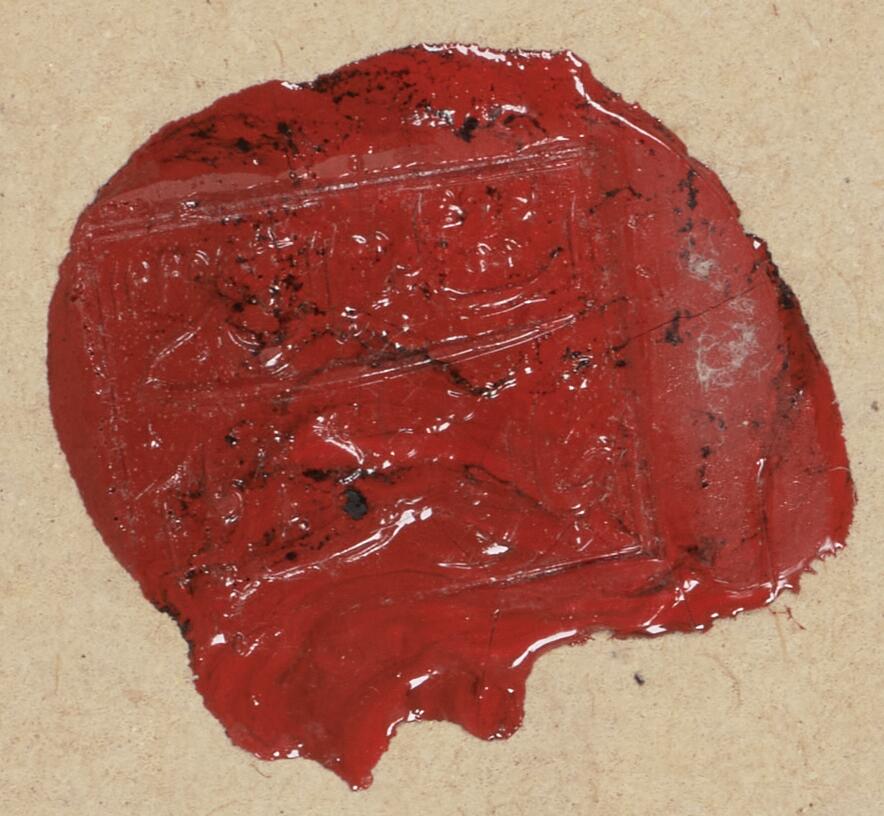
The fourth right flyleaf b side (f. ivb) bears a small, red rectangular wax seal, intaglio-carved in two stacked nasta‘līq script lines, double-ruled, with the name of former owner John Staples Harriott dated 1224 AH (1809–10 CE):‘ ات کپتان ۱۲۲۴
جان سٹیلس هاری ’
(Jān Staypils Hārī-āt, Kaptān, 1224).
12 × 14 mm.
The same wax seal also appears on Persian MS 55, folio 2a, Persian MS 90, right paste down, and 364, second right flyleaf (f. iia).History
Origin: Completed by Muḥammad Shafī‘ Qazvīnī, probably in Qazvin; 22 Shavvāl 1105 AH (16 June 1694 CE).Provenance and Acquisition
Subsequently acquired by British East India Company interpreter John Staples Harriott (1780–1839), who served in Bengal from 1798 to 1829, as per his red wax seal impression upon the fourth right flyleaf b side (f. ivb) and signature atop folio 1a.
After Harriott's death, his widow inherited then sold his library through the Alliance des Arts, Paris on 13 to 15 April 1843 (Nº 150), where scholar Nathaniel Bland (1803-1865) apparently purchased it and brought it to his home, Randalls Park, in Leatherhead, Surrey.
Curiously, in his sale 1841 catalogue of Harriott's library Jules Mohl notes two copies of this work, one dated much later, and another (p.22, no. 150) vaguely described as octavo-sized with ‘435 ff’, bound in Morocco leather, which nearly comports with the original colophon on 439b, yet it omits the scribe and date. This suggests that perhaps Bland possibly had the volume restored after he purchased it and that he may have also added the apocryphal seventh book to it at that time.
After Bland's death, London antiquarian dealer Bernard Quaritch (1819–1899) sold his oriental manuscripts to Alexander Lindsay, 25th Earl of Crawford (1812–1880) in June, 1866, paid in two instalments of £450 and £400, and then moved to Bibliotheca Lindesiana at Haigh Hall, Wigan.
Purchased by Enriqueta Rylands (1843–1908) in 1901 from James Ludovic Lindsay, 26th Earl of Crawford (1847–1913).
Bequeathed by Enriqueta Rylands (1843–1908) in 1908 to the John Rylands Library, Manchester.
Record Sources
Bibliographical description based on an index created by Reza Navabpour circa 1993, derived from a manuscript handlist by Michael Kerney, circa 1890s and his Bibliotheca Lindesiana, Hand-list of Oriental Manuscripts: Arabic, Persian, Turkish, 1898.
Manuscript description by Jake Benson in 2022 with reference to the volume in hand.
Availability
To book an in-person or online appointment to consult the manuscript, visit Using the Special Collections Reading Rooms. For any other enquiries please email uml.special-collections@manchester.ac.uk.
Bibliography
E. G. Browne, A Catalogue of Persian Manuscripts in the Library of the University of Cambridge, (Cambridge: Cambridge University press, 1896), pp. 313–315, nos. 224–226 [Cambridge University Library Oo.6.32, Gg.5.32, and Add. 199 (Lewis 19)].W. Chittick, The Philosophy of Ecstasy: Rumi and the Sufi Tradition. Bloomington: World Wisdom, 2014.W. C. Chittick, The Sufi Path of Love: The Spiritual Teachings of Rumi. Albany: State University of New York Press, 1983.H. Ethé, Catalogue of Persian manuscripts in the library of the India Office, Vol. 1 (London: Printed for the India Office by H. Hart, 1903), cols. 630–640, nos. 1060–85 [British Library, IO Islamic 2709, &c.].Gustav Flügel, Die Arabischen, Persischen und Türkischen Handschriften der Kaiserlich-Königlichen Hofbibliothik zu Wien, Bd. I (Vienna: Druck und Verlag der K. K. Hof und Staatsdruckerei, 1865), p. 514–515, no. 519 [Cod. N. F. 126].D. Forbes, Catalogue of Oriental Manuscripts, Chiefly Persian, Collected Within the Last Five and Thirty years, (London: W. H. Allen., 1866), p. 1, no. 2 [Rylands Persian MS 848]B. Furūzānfar, Sharḥ-i Mas̲navī-i sharīf. Tehran: Intishārāt-i Dānishgāh-i Tihrān, 1347–48 SH (1967–70 CE).F. D. Lewis, Rumi Past and Present East and West: The Life, Teachings and Poetry of Jalal al-Din Rumi Oxford: One World, 2000G. M. Meredith-Owens, Handlist of Persian Manuscripts, 1895–1966. (London: British Library, 1968), pp. 66, 68 [BL Or. 11677].Jules Mohl and Paul Lacroix, Catalogue de livres et manuscrits orientaux, provenant de la bibliothèque de feu M. John Staples Harriot... (Paris: Alliance des arts, 1843), p. 22, no. 150.G. H. Pertz, texts Die Handschriften-verzeichnisse der Königlichen Bibliothek zu Berlin, Bd. 4 (Berlin: Preussische Staatsbibliothek, 1853), pp. 783–791, nos. 762–772 [Staatsbibliotek zu Berlin, Minutoli 21 &c.].S. Rafiee-Rad, 'Persian Manuscripts in Samuel Robinson’s Collection in The John Rylands Library', Manuscripta: A Journal for Manuscript Research, Vol. 61, No. 2 (2017): pp. 273–275, pls. 7–8.C. Rieu, Catalogue of the Persian manuscripts in the British Museum, Vol. II (London: British Museum, 1881), pp. 584–587 [British Library Add. 27263, &c.].Jalāl al-Dīn Rūmī, The Masnavi of Rumi: A New English Translation with Persian Text and Explanatory Notes. Edited by M. Istiʻlāmī and translated by A. Williams. London: I.B. Tauris, 2020.Jalāl al-Dīn Rūmī, The Mathnawí of Jalálu'ddín Rúmi The Mathnawí of Jalálu'ddín Rúmi. Edited and translated by R. A. Nicholson. London: Luzac & Co., 1925–1940.Jalāl al-Dīn Rūmī, Masnavi I Ma'navi : The Spiritual Couplets of Maulána Jalálu'd-Dín Muhammad I Rúmí, 2nd ed. Translated by E. H. Whinfield. London: Paul, Trench, Trubner & Co., Ltd., 1898.Jalāl al-Dīn Rūmī, Kullīyāt-i Mas̲navī-i Maʻnavī-i. Edited by B. Furūzānfar, with commentary by M. Darvīsh. Tehran: Intishārāt-i Jāvīdān, 1342 SH (1963 CE).E. Sachau and H. Ethé, Catalogue of the Persian, Turkish, Hindûstani, and Pushtû manuscripts in the Bodleian Library, Vol. I (Oxford: Clarendon Press, 1889), cols. 511–516, nos. 646–660 [Bodleian Ouseley Add. 146].Funding of Cataloguing
Iran Heritage Foundation
The John Rylands Research Institute
TO TOP
See the Availability section of this record for information on viewing the item in a reading room.